Differences between the Montessori method and the Waldorf method
When it comes to choosing a daycare or school, many parents look for different pedagogical systems in which to educate their children, which is why methods previously known only by education professionals are now being sought after. Waldorf It seems like you accidentally sent a message with just the letter "o". Please let me know if you need any help or information! Montessori, they have increased their popularity and their offerings in our country.
As we saw in the different posts dedicated to learning about these methods, both were developed at the beginning of the 20th century, and, despite that, they are still current and gaining more followers.
This is because the main principle of these educational methods is to educate children and young people in freedom, achieving a complete development of all intellectual, physical, and spiritual capacities. Although the goal is practically the same for both methodologies, each one has developed its own pedagogical approach, focusing on what they consider most important to achieve their objective.
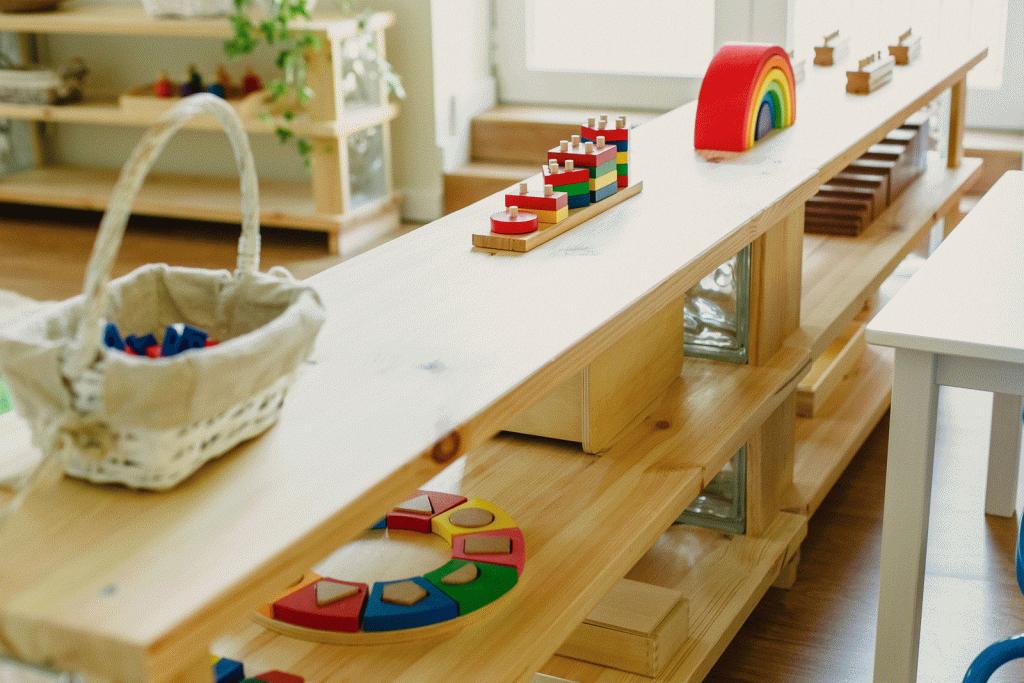
Montessori and Waldorf MaterialsMain differences
The first difference we find between these two methods is the influence that the ideology of their founder has on each pedagogical approach. The Waldorf method was developed by Rudolf Steiner, philosopher, educator, artist, playwright, and thinker. He is the founder of anthroposophy, which is why this methodology uses art as its foundation. On the other hand, the Montessori method was developed by [person's name]. Maria Montessori, an Italian educator and physician who proposes a child's development through activities that promote discovery, exploration, play, and practice in a prepared space where the child freely chooses the work that interests them the most.
And that is where the big difference between the two lies, in their curriculum. While in the Montessori method the teacher acts as a "guide," observing the child and adapting activities to their needs, and the child is the one who chooses the activities to do, in the Waldorf method the teacher does intervene in the class by proposing practical tasks. In addition, artistic work like drawing, painting, or music is introduced; practical tasks such as gardening, cooking, or cleaning; and the most important element for this method, eurythmy, which is the art of movement that accompanies texts or music and includes elements of theater and dance.

Similarities between both methods.
The main similarity we find between these methods is that both divide the different stages of a child's development into phases. In the case of Montessori, its author argued that children go through 4 evolutionary periods from infancy to adulthood which she calls "planes of development." The first plane goes from birth to 6 years old, the second from 6 to 12, the third from 12 to 18, and the final developmental plane goes from 18 to 24 years old. For Steiner, there are only three stages of development: early childhood (preschool), primary education (from 6-7 years to 12-14), and secondary education (from 12-14 years onwards).
In the foreground of development, both methods propose that children learn through imitation, which is why this approach is based on practical activities and experiences. The materials used are natural, such as wood, which lend themselves to imaginative play, and the tools mimic and facilitate tasks done at home or in the community: washing, cooking, and even gardening. Classroom work is combined with outdoor time. Additionally, mythology, art, and eurythmy are important for the Waldorf method. Eurythmy is the art of movement that accompanies texts or music and includes elements of theater and dance.
It is in primary education or in the second stage of development, that is, from 6-7 years old, when reading and writing begin to be introduced in both methods through specific activities and materials for this purpose.
For the Waldorf method, these activities coexist with artistic, manual, and musical work that becomes more complex at this stage, teaching skills such as sewing, wood and stone carving, making dolls and puppets, or working with metal.
Secondary education for the Waldorf method or the third plane of development for Montessori focuses on academic subjects such as astronomy, mathematics, physics, etc., only including standardized tests afterwards.
For the Waldorf method, languages are also important, which is why they teach English and German from first grade.
Did you know about these methods? What do you find most interesting about them? Would you like to educate your children using any of these methods?
Leave a comment
Log in to post comments
Comments
ximena romero
By: Ximena romero On May 26th 2021La metodología Montessori la conozco, me gusta mucho. Pero prefiero Waldorf, porque el profesor interviene proponiendo tareas prácticas y además por introducir el arte a las actividades. Me encantaría que mi niña se eduque en un colegio que utilice este método.
Odet Serrano Suárez
By: Odet Serrano Suárez On April 24th 2021Recién encontré información sobre el método Waldorf, el Montessori ya lo conocía. Los dos me gustan mucho, aunque debo confesar que el Waldorf me ha fascinado. Me encantaría que mi pequeño recibiera educación en una de las escuelas que optan por este método tan genial!