Tips to prevent plagiocephaly in babies
What is plagiocephaly?
Plagiocephaly is a cranial malformation that occurs in some babies during their first months of life. This happens when the baby's head is subjected to certain pressures for a prolonged period of time. In other words, when the baby spends a lot of time with their head resting on a flat surface like their crib, swing, or stroller. In some cases, this deformity can even be intrauterine, from being in the same position for a few weeks.
This malformation is affecting more and more babies due to a change in the recommendation for the sleeping position of babies made by the American Academy of Pediatrics. Until 1992, this association recommended that babies sleep on their stomachs. However, to combat Sudden Infant Death Syndrome, they began recommending that babies sleep on their backs, with their heads turned to the side. While this reduced cases of sudden death, it led to an increase in cases of flat head syndrome.

Types of plagiocephaly
Plagiocephaly is classified as mild or severe.
< p>Most cases are mild, with no risks or other associated problems. It is an aesthetic issue that can be corrected by following some recommendations.Severe cases, on the other hand, require evaluation and treatment by a specialist. One of the most common treatments is the use of a cranial orthosis or helmet. The earlier the treatment starts, the more effective it will be. It is recommended to start between 5 and 6 months of age, as later, the skull bones will be more fused and it will be more difficult to correct.
How to prevent plagiocephaly
Change positions. The most popular measure is to lay the baby down in different positions. On their back with their back against the mattress, or lying on their right side and left side, alternating them.
If you practice co-sleeping or have the baby's crib next to your bed, it is advisable to change the position in which you lay the baby down or the crib's position; with the baby's head at the headboard one day and at the foot of the crib the next day. This way, the baby won't always rest their head on the same side.
When the baby is awake, place them on their tummy for short periods. This measure, in addition to preventing plagiocephaly, will help strengthen the muscles of the neck and back.
To prevent the baby from lying down with their head resting on any surface all the time, it is good to pick them up in your arms, alternating between the left and right arms so they can rest their head on both sides. You can even place them on their tummy, a position that also helps relieve infant colic.
Vary the method of transportation you choose for the baby, among the stroller, your arms, baby carriers, and wraps that allow the baby's head not to be resting.
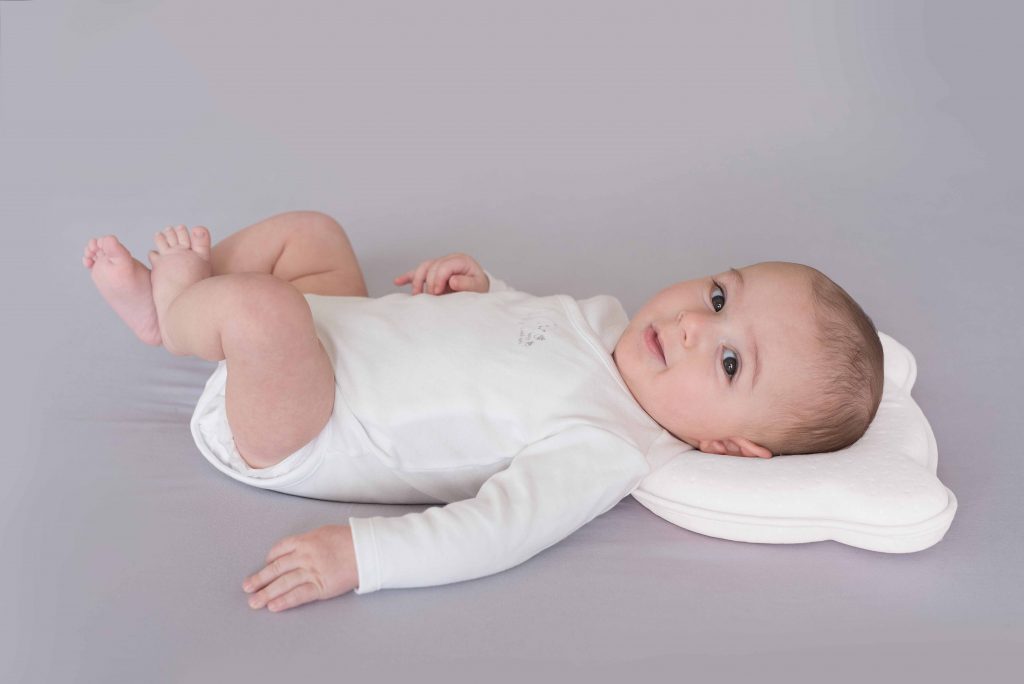
The use of ergonomic pillows is also very beneficial for preventing and correcting this anomaly. Their ergonomic design with a central cavity ensures a better fit for the head. And their soft material fabric with memory foam filling helps the baby's skull develop correctly and aids in falling asleep.
In Olmitos, we have designed this bear-shaped pillow to keep your baby comfortable at all times.

Leave a comment
Log in to post comments